
🎬 Multilingual subtitles
✍️ By: Team BC1.NL


New safety standards demand innovation in dike reinforcement
In January 2017, the Dutch government introduced new safety standards for dikes in the Netherlands.  This has posed a significant challenge for Rijkswaterstaat and the water boards in strengthening the dikes. As a result, they are looking for faster and more cost-effective solutions. Mourik, based in Groot-Ammers, is implementing an innovative reinforcement project on the IJsseldike in Gouda. The dike is being strengthened over a length of approximately one kilometer on behalf of the Rijnland Water Board.
Leanda Bogaards, environmental manager for the project on behalf of Mourik, proudly talks about this method in the video. Together with the Rijnland Water Board, Mourik won the Audience Award at the Water Innovation Award 2017 for this achievement.
New technique in dike reinforcement
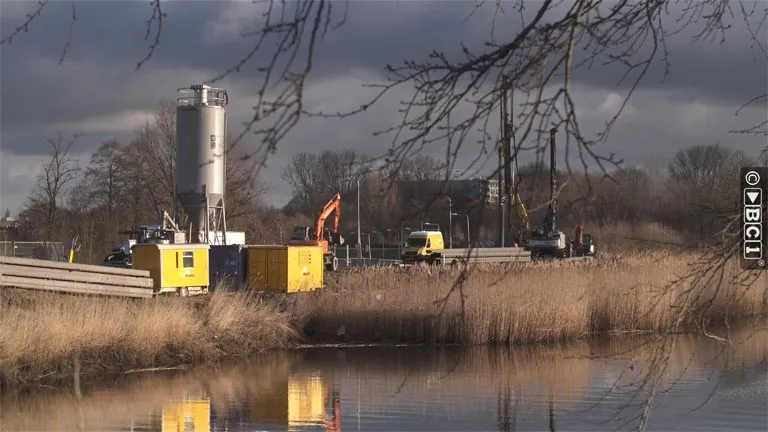 In the video, Bert Everts, a geotechnical expert at Mourik, explains the use of the soil-mixing technique, which has never been used before in dike reinforcement. One of the major advantages of this method is that it reduces the need to transport raw materials to the site. Instead, the technique utilizes the soil already present in the dike. The soil is mixed on-site with cement to create a panel within the ground, strengthening the dike. While this method is commonly used for applications such as parking garages or sandy soils, it has never before been applied to dikes with clay and peat soils.
Less disruption and lower costs
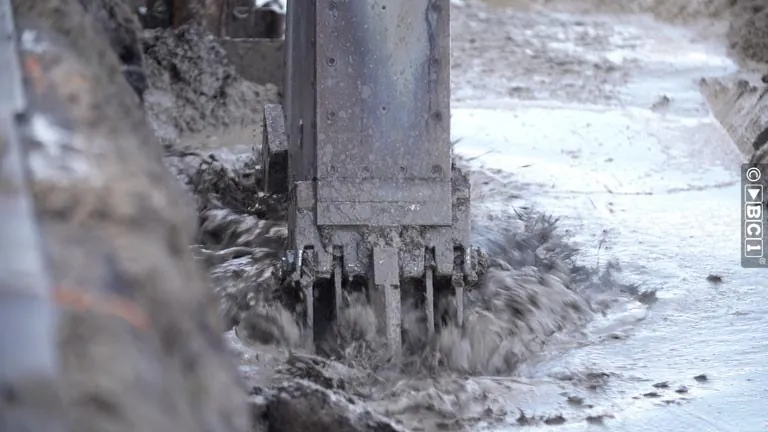 In a densely built-up area like Gouda, where many houses are located next to the dike and significant through traffic passes nearby, this technique offers an excellent solution. If the dike had been reinforced with sheet piles, much more space would have been needed to carry out the work. Additionally, the intense vibrations could have posed a risk of cracks forming in nearby homes.
With the soil-mixing method, disruption for both residents and traffic is kept to a minimum. According to Henk Weijers, project manager at the Rijnland Water Board, this along with the reduced costs, was a key factor in the decision to adopt this method.
Also interesting:
Self-healing bio-based concrete

